
Elite Squash as a driver of squash development: Victor Crouin’s perspective
Our first meeting? My very first tournament. I ran into Victor in the first round. I was three years older and two heads taller than him. I told my coach: "I’m going to crush this little guy." The result?
- First game: 11–0. Well… I’m stressed.
- Second: 11–9. That’s it, I’ve got it!
- Third: 11–0. Welcome to the world of squash. 😂
Victor today 👋🇫🇷
Victor Crouin, world No. 11, is an active figure in international squash. Originally from La Valette, near Toulon, he grew up in a club where his father was both deputy director and coach.
What stands out about him today is his reflection on the sport as a whole. Unlike many high-level athletes who focus solely on their own performance, he also wants to understand how to advance squash as a discipline. He’s active on social media, shares his passion, plays with kids whenever he can, and isn’t afraid to challenge conventional wisdom. He’s not content to just perform: he wants to understand, to pass on knowledge, to help his sport grow.
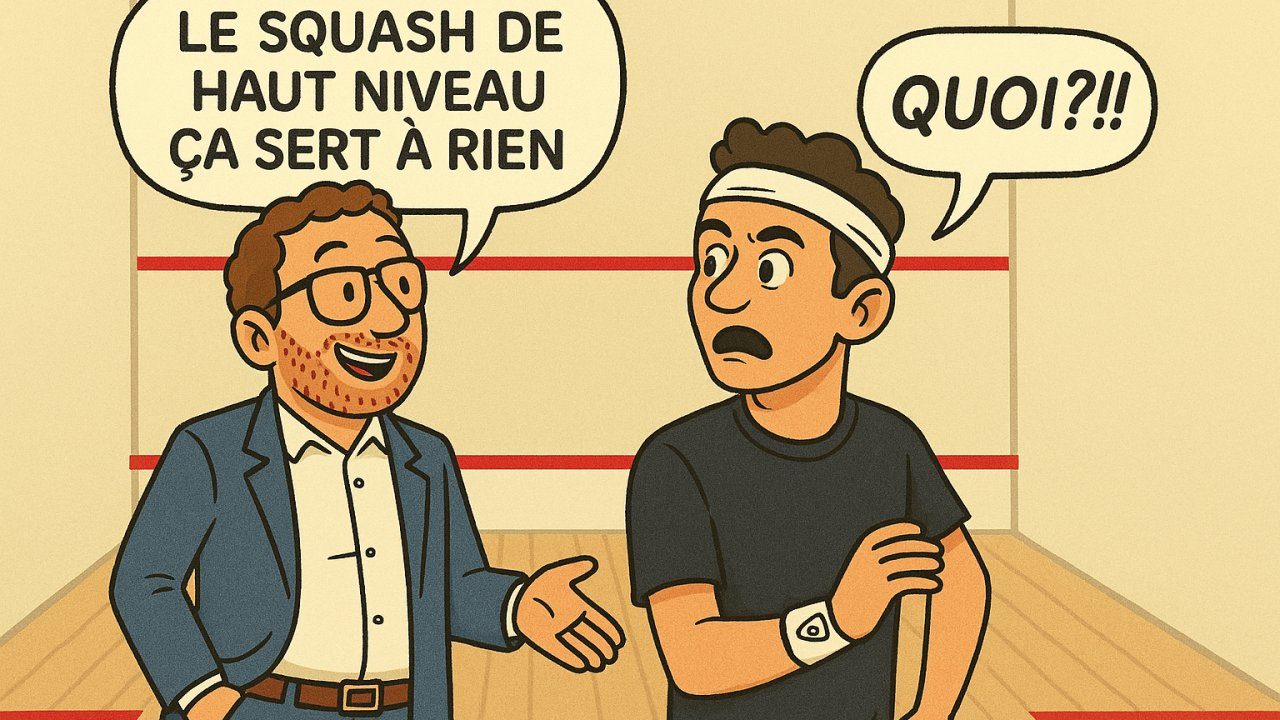
It’s in this context that he reacted to an article where I argued that high-level performance had no direct link with the general development of squash. Victor disagreed. Perfect — we could talk about it.
Elite Squash: a product to sell 🛠️🎯📈
"Elite Squash is a product. You have to learn how to sell it, make it desirable, visible, distribute it, and above all, make it known."
Victor gives the example of tennis: in any club, discussions revolve around the pros. As a kid, he wanted "Nadal’s racket."
And squash? It has its champions — but no one uses them.
"High-level sport is like a screwdriver. A good tool. But if you don’t know how to use it, you’ll build crappy furniture." So the problem isn’t the tool itself, but how it’s used. Which means — you need a strategy.
Okay, Victor, fair enough… but then, how do we do it?
The La Valette example 🏡📣
At his father’s club in La Valette, near Toulon, the restaurant’s placemats printed the results of the club’s players. Curious customers would ask: "Who’s this kid?" And they’d answer: "That’s the No. 1 French player. Want to give it a try?"
Even today, when Victor trains in a club, people stop to watch, to talk, to have a beer while watching him play. It’s a natural engine for activity.
High-level sport becomes a living medium: it attracts, intrigues, inspires. It triggers consumption, emotion, progress — and often loyalty.
The fundamental role of the coach: beyond the ball-pusher 👨🏫💬
Victor is adamant: a club cannot survive without a committed coach. For a long time, we had “squash pros” who went from one club to another, motorcycle helmet on their head, without any local roots or involvement. Clubs didn’t want to hire: too expensive to employ people, and giving lessons for cash — that’s not a life.
A good coach is:
- 🧠 A trainer : follows players, builds cycles, thinks about progression.
- 💬 An educator : passes on values, introduces the great players.
- 🎉 An animator : organizes tournaments, sells equipment, builds community, organizes matches, looks for partners.
Yes, it’s more expensive than a roaming pro. But it’s an investment that keeps the club alive in the long run — and it pays off (new players, playing more often, buying equipment, etc.).
Victor’s dream? A trained, certified coach in every club.
The virtuous circle: youth, families, passion 🔄👨👩👧👦
The foundation of development is the youth. Why? Because they bring their parents.
"You, me, and many players we know — we all started because our parents played." And sometimes the reverse: children motivate their parents to play. It’s a constant back-and-forth.
A virtuous circle. Without a base, there’s no elite. But without an elite… it’s hard to create the base. The two go hand in hand.
Rackets: one family 🎾🏸
Victor doesn’t see other racket sports as competitors. On the contrary:
"A teenager can play squash in winter, padel in summer, have a ping-pong racket for school breaks, and hit tennis balls with their parents on vacation..." That’s a good sign. The more rackets, the more fun, anyway.
And what if we took squash outdoors? 🌳🏟️
Victor’s dream? Build outdoor courts.
Visible, public courts, installed in iconic locations. Jardin du Luxembourg? Toulon? Let’s make a bet: who will be first? 😄
It would be a fantastic visibility boost. You walk past, you see people playing… you want to try, you put café chairs all around: perfect!
Squash at the Olympics: it’s up to us to make something of it 🏅🌍
Squash’s entry into the Olympic Games? Huge. But Victor warns:
"It’s a tool. Not a miracle solution." We’ll have to use it wisely: promote it, structure it, train, share. Once again, it’s a fantastic tool — but will we have the right people to work with it?
So? Are you optimistic for the future? 💪🏽
Squash has tremendous assets. But we have to stop waiting for miracles. Good things are underway: squash’s arrival on Sport en France , for example! Millions of people now see squash — for free!
And if you could dream, what would you do for squash in a snap of your fingers?
- A trained coach in every club
- Public facilities to welcome players
- Outdoor courts to showcase the sport
High-level sport is not the solution. But well used, it’s a powerful lever.
It’s up to us to build the right furniture with it! And for Rémy, one of the paths to that ideal is through sport.