
Tennis - The Real-Estate Giant Renovating in Three National Modes
Tennis is the largest racquet sport in the world by every meaningful measure: 106 million participants globally , 698,000 courts across 43 countries with comprehensive ITF inventory, and a structural depth of national federations, professional tours, and educational pipelines that no other racquet sport approaches. Tennis is also the racquet sport with the largest single-court footprint — approximately 670 square metres for the playing surface alone — and therefore the largest building cost per court when delivered indoor. This combination produces a paradox that defines the sport’s investment landscape: tennis has more demand and more infrastructure than any racquet sport, but its per-court real-estate burden is the highest, which forces the renovation race that this article documents.
The renovation is happening in three different modes in three different markets. Germany has built the world’s largest member-club tennis system — predominantly outdoor, predominantly member-club — and is now augmenting that base with padel courts and multi-sport conversions. The United Kingdom runs a hybrid of public park courts and private member clubs, with substantial public investment in park-court refurbishment running parallel to a private member-club tradition. The United States operates a mixed model built on a strong collegiate pipeline, commercial racquet-club chains, and a country-club tradition. All three are responding to the same underlying pressure — the size of the tennis court footprint relative to rising real-estate values in dense urban markets — through different facility-type architectures .
The tennis player: who they are, why they play, how often
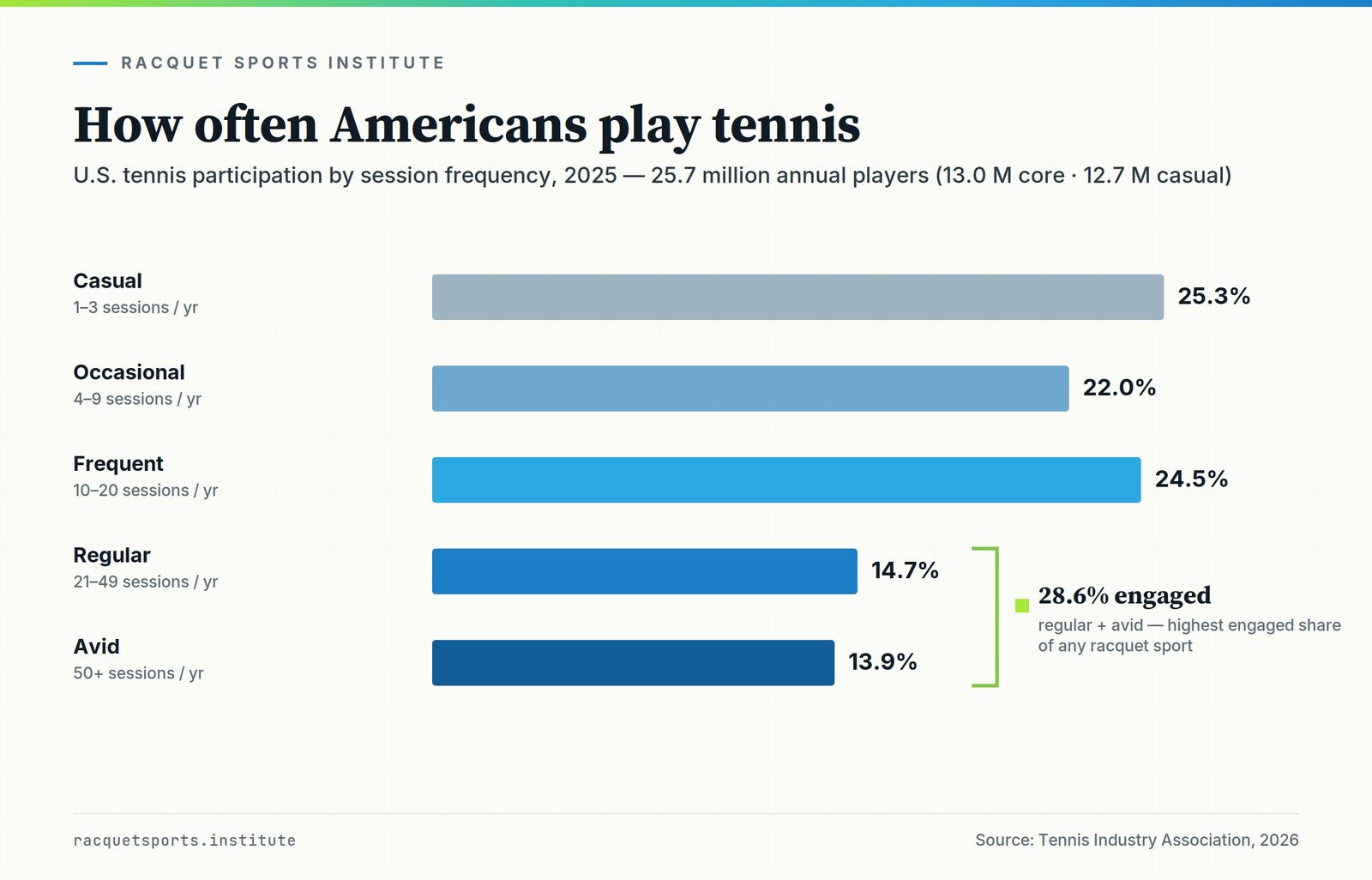
Tennis has the most extensively documented player segmentation of any racquet sport, courtesy of the Tennis Industry Association’s annual participation reports. The 2025 U.S. data shows approximately 25.7 million annual players , of whom 13.0 million are core players (10 or more sessions per year) and 12.7 million are casual. The frequency distribution within the U.S. base is the most granular available : 25.3 percent are casual (1–3 sessions per year), 22.0 percent are occasional (4–9), 24.5 percent are frequent (10–20), 14.7 percent are regular (21–49), and 13.9 percent are avid (50 or more sessions per year). Avid plus regular players together — the equivalent of the master pyramid’s fanatic-plus-enthusiast tiers at 18 percent — make up 28.6 percent of the U.S. tennis base, the highest engaged-player share of any racquet sport.
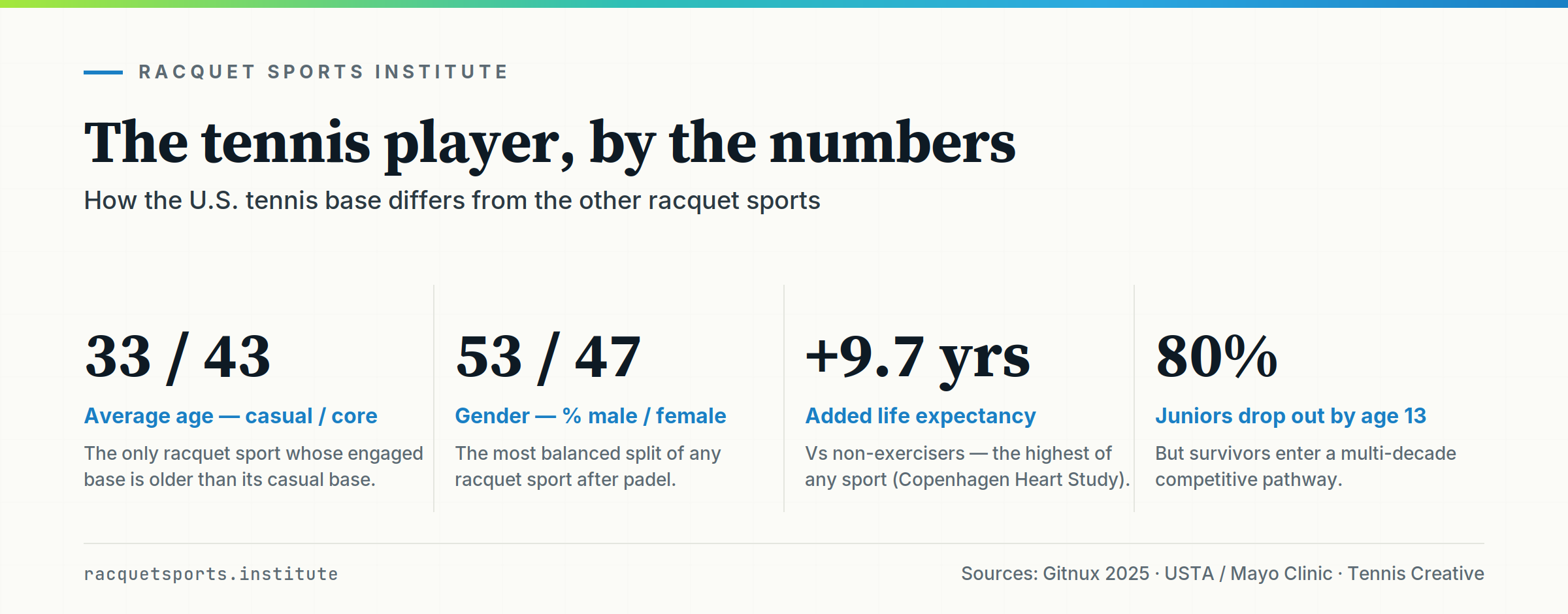
U.S. tennis player: average age 33 casual versus 43 core (the only racquet sport whose engaged base is older), a 53/47 male-female split and 80% of juniors dropping out by age 13. Sources: Gitnux 2025, USTA / Mayo Clinic, Tennis Creative.
Tennis demographics differ meaningfully from the other racquet sports. The average casual tennis player is 33; the average core player is 43 , the only racquet sport where the engaged player base is significantly older than the casual base. The gender split runs approximately 53 percent male and 47 percent female globally, the most balanced of any racquet sport after padel. Income skews above the national median in Western markets, particularly within the country-club segment. Junior participation is structurally embedded through national federations: 80 percent of youth tennis participants drop out by age 13 , but the survivors flow into a multi-decade competitive pathway that produces a deep adult core layer.
The motivational hierarchy in tennis is the most mastery-and-tradition-weighted of any racquet sport. Skill mastery and improvement rank first — tennis demands years of skill investment before satisfying play begins, which is both a barrier to entry and a long-term retention driver once the threshold is cleared. Competition ranks second, embedded structurally through the LTA, USTA, DTB, and FFT ranking systems, the LK and UTR rating systems, and the broader culture of league play. Health and longevity rank third — the Mayo Clinic’s Copenhagen Heart Study found that tennis players live on average 9.7 years longer than non-exercisers , the highest longevity benefit of any sport in the study. Social and identity ranks fourth, embedded through member-club culture and the country-club tradition. Tennis is the racquet sport where the player’s relationship with the sport is the longest in absolute terms — multi-decade competitive engagement is the norm, not the exception.
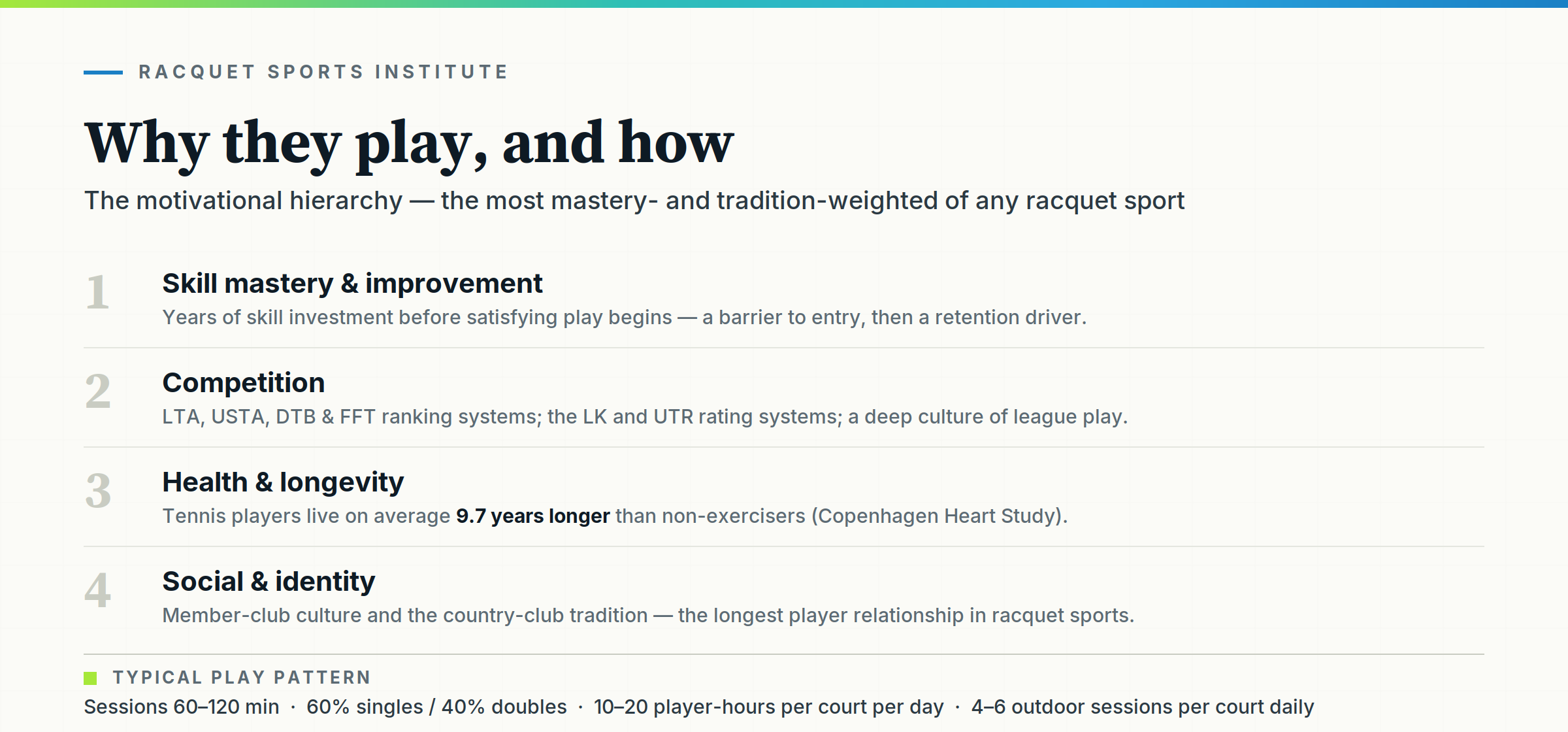
Ranked motivational hierarchy for tennis — 1) skill mastery and improvement, 2) competition, 3) health and longevity (+9.7 years), 4) social and identity.
Sessions are typically 60 to 120 minutes, longer than any other racquet sport. A tennis court operating outdoor in a member club delivers four to six sessions per day at typical utilisation; an indoor commercial tennis court must deliver more sessions to recover its higher capex. Tennis is the most singles-and-doubles flexible of the racquet sports, with roughly 60 percent of recreational play in singles and 40 percent in doubles. Player-hours per court per day range from 10 to 20 depending on session length and singles-doubles mix.
Indoor versus outdoor: the central economic question of tennis
Tennis is the racquet sport where the indoor-versus-outdoor decision is most consequential and most clearly resolved by climate and economics. The German federation’s 2025 inventory shows the structural answer: 44,454 tennis courts in Germany split as 40,433 outdoor and 5,424 indoor — a 91 percent outdoor share . The same pattern holds across most of continental Europe, the U.S. Sunbelt, Australia, and Latin America: tennis is predominantly outdoor because the indoor capex burden of a 670-square-metre playing surface is the highest in racquet sports.
A standard indoor tennis court runs at EUR 350,000 to 500,000 per court when integrated into a multi-court facility, but a single-court indoor tennis facility can run materially higher because the building shell does not amortise across enough courts to justify the construction cost. An outdoor tennis court — particularly clay or hard court — runs at EUR 30,000 to 80,000 in court construction alone with minimal building infrastructure required. The ratio of indoor to outdoor capex per court is roughly 5:1 for tennis, the highest indoor premium of any racquet sport.
The strategic consequence is structural. In climates where outdoor tennis is genuinely viable for 7 or more months per year — most of continental Europe, the U.S. Sunbelt, Australia, Latin America — outdoor tennis is the load-bearing infrastructure and indoor tennis exists primarily as a winter complement absorbed by member clubs. In Northern Europe, the U.S. Northeast, Canada, and the Asian monsoon belt, outdoor utilisation collapses for half the year and indoor tennis carries more of the operational load — but the per-court capex is so high that pure commercial indoor tennis operations are rare and tend to combine tennis with hotel, fitness, or multi-sport offerings to amortise the building. The renovation race documented below is, in part, a response to this fundamental indoor-tennis capex problem.
Lens 1: Germany — the member-club republic
Germany operates the largest member-club tennis system in the world. The Deutscher Tennis Bund counts approximately 1.49 million members across 8,640 clubs and 44,454 courts as of 2025 — the largest tennis federation in the world by active membership. The system is overwhelmingly member-club, structurally outdoor (91 percent of the inventory), and built on annual membership dues rather than per-hour court bookings.
The German model insulates tennis from the commercial per-hour pressures documented in Articles 2 and 4. Members pay annual dues that fund club operations regardless of weekly court demand, which means German tennis clubs do not face the per-hour-yield pressure that has killed standalone commercial tennis operations in higher-cost real-estate markets. The downside of the model is its limited capacity to absorb new entrants without expanding the club inventory — a constraint that has driven the most interesting recent development in German tennis: the padel augmentation strategy.
Many German tennis clubs are now adding two to four padel courts within their existing footprints. The economics are attractive: a single tennis court can be repurposed into three padel courts at modest capex, and the padel courts attract a younger, more gender-balanced member base that complements rather than displaces the existing tennis membership. This is the member-club dual-business logic at its most elegant — the leisure operation expands its product line, the real-estate asset (the existing club land and buildings) generates higher per-square-metre revenue, and member retention strengthens because the club becomes a multi-product racquet-sports destination rather than a single-product tennis facility.
Lens 2: United Kingdom — public investment meets member-club tradition
The United Kingdom operates a hybrid of public park courts and private member clubs that is unique in the global tennis landscape. On the public side, the UK government and the Lawn Tennis Association have committed approximately £30 million to refurbishing public park tennis courts across the country, explicitly targeting mass-participation outcomes through free or low-cost public access. On the private side, the UK retains the most iconic member-club inventory in tennis: the All England Lawn Tennis and Croquet Club (Wimbledon), the Queen’s Club, the Hurlingham Club, and a deep tier of regional member clubs.
The UK model demonstrates that public and private tennis can grow in parallel rather than in competition. The public-court refurbishment programme is bringing new players into the sport at the casual end of the funnel, while the member-club tradition continues to anchor the engaged-player tier. The LTA has explicitly integrated padel into its organisational pathway, which is part of what is driving the extraordinary UK padel growth documented in Article 2. The combination of public investment, member-club tradition, and integrated multi-product federation governance produces what is currently one of the strongest racquet-sports policy environments in the world.
Lens 3: United States — the mixed model with college pipeline
The United States operates the most diverse tennis facility-type architecture of the three regions. The 25.7 million annual U.S. tennis players are served through a mixed inventory of country clubs (the legacy private-club tradition), commercial racquet clubs (Life Time Athletic, ClubCorp, regional chains), public courts (parks, recreation departments, municipal facilities), and collegiate facilities. The ITF estimates a global shortage of approximately 180,000 tennis courts based on optimal player-to-court ratios, with the U.S. carrying a meaningful portion of that gap.
The collegiate pipeline is the U.S. tennis structural advantage. NCAA Division I tennis programmes operate as a major junior-development pipeline, with university scholarships incentivising junior tennis investment in a way that produces a continuously refreshing core-player base. Roughly 45,000 active U.S. participants flow through university and college club tennis annually , providing both the elite player pipeline and a large adult-recreational base who learned the sport through institutional channels. The U.S. also has the most active premium commercial tennis sector — Life Time Athletic and similar chains have built indoor tennis as a premium fitness-and-leisure product where the building shell is amortised across spa, gym, and multi-sport offerings rather than relying on tennis court bookings alone.
The Tennis Club market segment is valued at approximately USD 1.9 billion in 2024 and is projected to reach approximately USD 3.0 billion by 2031 , with growth concentrated in mixed-use facilities rather than single-product tennis clubs. The pattern echoes the German padel-augmentation logic: the most attractive U.S. tennis investments are increasingly multi-product, with tennis as the anchor amenity rather than the sole revenue source.
Reality check: 100 to 150 players per court applied to tennis
Tennis presents the cleanest 100-to-150-players-per-court alignment of any racquet sport. The ITF’s 106 million global players against approximately 698,000 courts produces a ratio of 152 players per court — squarely within the viable commercial range and within the operational target the Tennis Industry Association uses for U.S. market analysis. In aggregate terms, global tennis is approximately balanced between supply and demand, which is consistent with the sport’s relative stability in player participation over the past decade.
Regional variations matter. Germany at 1.49 million DTB members against 44,454 courts produces a ratio of 33 active players per court — well below the commercial viability threshold, but operationally fine within the member-club model where courts are filled by club programmes, leagues, and member access rather than by per-hour commercial bookings. The U.S. at 25.7 million players against approximately 270,000 courts (ITF estimate) produces a ratio of 95 active players per court — close to the commercial viability lower bound, with significant geographic variation between Sunbelt high-demand markets and Northern climate-constrained markets.
The strategic implication is that tennis is the racquet sport closest to operational equilibrium between supply and demand. New tennis court development in mature markets is generally unattractive at the macro level, with two specific exceptions: Sunbelt urban catchments where demand is genuinely outpacing supply, and the multi-sport conversion thesis where adding tennis courts to existing fitness-and-leisure venues uses tennis as one product within a broader portfolio rather than as the primary load-bearing revenue source.
What the other racquet sports can learn from tennis
Because tennis is the oldest of the five sports, its facility history is the closest thing the racquet-sports world has to a finished experiment — and four of its lessons transfer directly to padel, pickleball, squash, and badminton. The first is that the single-product commercial model is the fragile one. The standalone indoor tennis operations that failed across central Europe and the U.S. Northeast did not collapse because tennis lost players; they collapsed because a 670-square-metre court could not generate enough revenue per square metre to service expensive real estate on court bookings alone. The sports growing fastest today will repeat that mistake if they build single-product commercial venues, and avoid it if they build multi-product facilities from the outset , where the building shell is amortised across several revenue lines rather than one.
The second lesson is that membership dues beat per-hour yield. The German system — 1.49 million members funding club operations through annual dues — proved structurally more durable than any commercial model precisely because it decoupled a club’s survival from weekly court demand. Any racquet sport that can build a genuine membership culture inherits the same insulation against real-estate cost shocks. The third lesson is that public and private capacity grow together rather than against each other: the UK’s roughly £30 million public park-court programme expands the casual base while the member-club tier anchors the engaged players — a template padel and pickleball governing bodies are already copying.
The fourth lesson is the hardest to act on, because it requires planning against a saturation point that is still years away for the younger sports. Tennis reached macro-equilibrium at roughly 152 players per court , the level at which new construction stops paying for itself, and its 670-square-metre footprint is what forced the renovation race in the first place. Squash, badminton, and padel carry far smaller footprints and therefore far more conversion optionality — a single tennis court already becomes three padel courts — but the economics of court density are unforgiving once a market is built out. The sports that map their own saturation point before they reach it will renovate on their own terms; the ones that wait will renovate on the market’s terms, as tennis is doing now.
What can tennis learn from the other racquet sports
The lesson runs in both directions, and tennis has as much to learn as it has to teach. From padel it learns footprint efficiency. Padel’s small, enclosed, doubles-default court fills faster and earns more revenue per square metre than a 670-square-metre singles court — which is exactly why the smartest German clubs convert one tennis court into three padel courts rather than build more tennis. That conversion is not a concession; it is tennis importing padel’s revenue density .
The most important lesson, though, is about the coaching barrier — the single biggest acquisition disadvantage tennis carries. Tennis is effectively unplayable without instruction: a beginner cannot sustain a rally, serve, or score without weeks of paid coaching, which is part of why roughly 80 percent of its junior players drop out by age 13 before the skill threshold is ever cleared. Padel, pickleball, and badminton invert this entirely. Two complete beginners can pick up a padel or pickleball court and play a real, enjoyable game within minutes, with little or no coaching; badminton is playable in any backyard or hall on the first attempt. That day-one playability is not a minor convenience — it is the structural reason those three sports convert curious newcomers into returning players so much faster than tennis, and it is why their funnels widen at the casual end while tennis’s narrows. Tennis cannot remove its own skill ceiling, but it can borrow the format: the slower-ball, shorter-court, no-coaching-required entry formats — cardio tennis, short-court junior tennis, social doubles formats — are tennis deliberately importing the low coaching barrier that padel, pickleball, and badminton enjoy by default.
From squash and badminton it learns building-shell economics. Both sports stack several courts inside a single indoor shell and spread the most expensive part of any indoor facility — the building — across many revenue-generating courts, whereas a single indoor tennis court must carry that shell almost alone, the source of tennis’s roughly 5:1 indoor capex premium . And from all four younger sports it learns the same structural truth its own renovation race is now proving: the venues that endure are multi-product, not single-product , and the most resilient tennis investment is increasingly the mixed-use facility where tennis is one product among several rather than the sole load-bearing revenue line. The elder sport’s next chapter is being written, in part, by the younger ones.
Tennis closes this series because it shows what happens to a racquet sport over a multi-generational time horizon. Every economic dynamic this series has documented in padel, pickleball, squash, and badminton has played out before in tennis — the early-stage growth, the maturity-phase consolidation, the public-private tension, the facility-type architecture variations, the renovation race driven by real-estate appreciation. Tennis is the elder racquet sport, and its current state is the long-run trajectory the others are on. The five sports are not in competition with each other; they are five distinct customer products serving five distinct human prototypes, and they share the same underlying business mathematics.
The court is the stage. The show is everything else.